Leaderboard

Radiology’s Last Exam (RadLE) 2.0

A Benchmark for Autonomous Diagnosis by AI agents in Radiology

Key findings

12

Board certified radiologists and radiology trainees scored on RadLE 2.0

16

Frontier and open-source models scored on the same exam

448

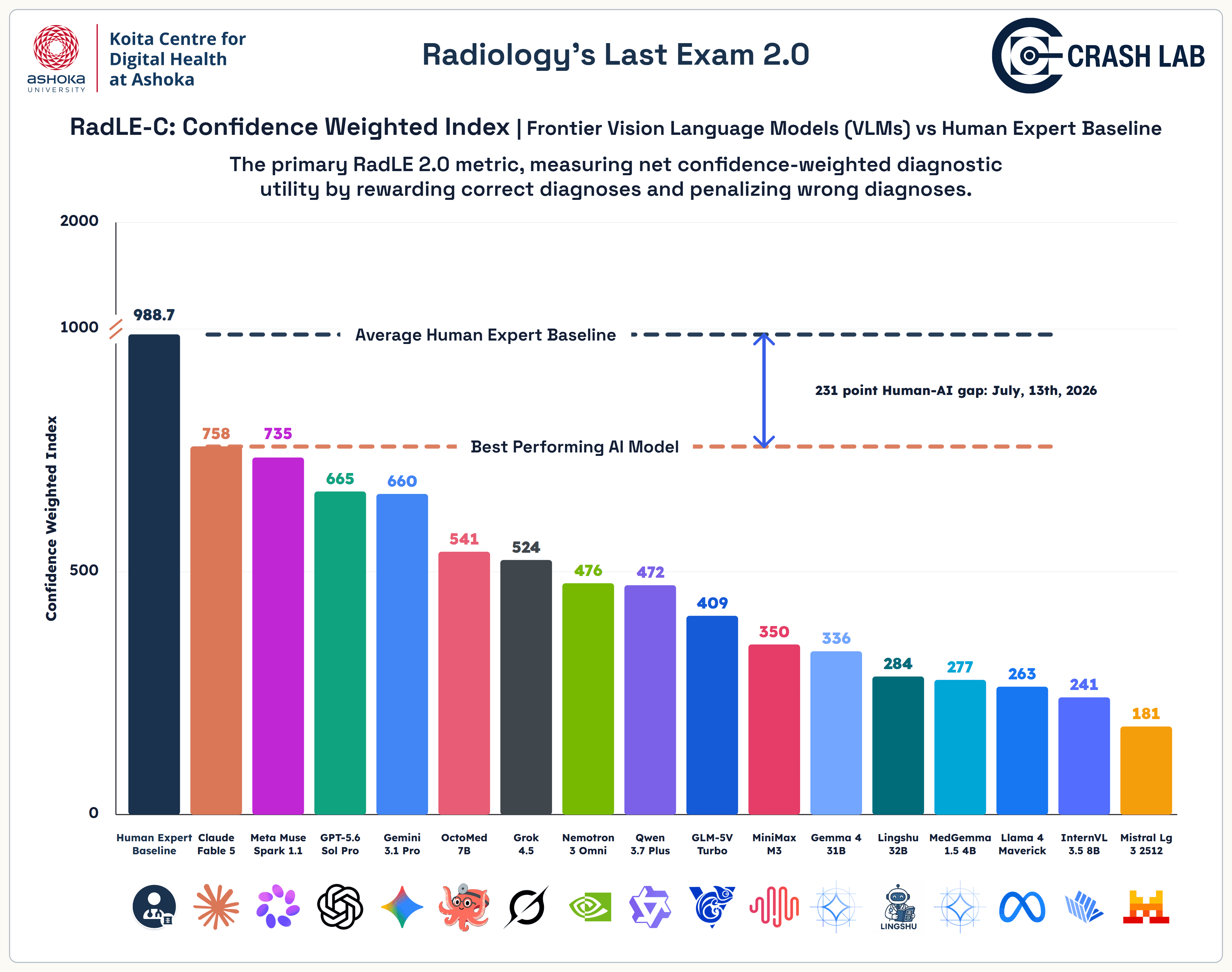
Average AI score, on a scale running 0 to 2000

231

Point gap between the human experts (988.7) and the best model, Claude Fable 5 (758)

Primary RadLE 2.0 metric; net confidence-weighted diagnostic utility.

All Models: 16 of 16 AI models shown against the human expert baseline.

RadLE-C leaderboard data
ModelProviderScore
Human Expert Baselinehuman comparator988.7
Claude Fable 5Anthropic758
Meta Muse Spark 1.1Meta Model API735
GPT-5.6 Sol ProOpenAI665
Gemini 3.1 ProGoogle660
OctoMed 7BOctoMed (academic)541
Grok 4.5xAI524
Nemotron 3 OmniNvidia476
Qwen 3.7 PlusAlibaba472
GLM-5V TurboZ.AI409
MiniMax M3MiniMax350
Gemma 4 31BGoogle336
Lingshu 32BAlibaba DAMO Academy284
MedGemma 1.5 4BGoogle277
Llama 4 MaverickMeta263
InternVL 3.5 8BOpenGVLab241
Mistral Lg 3 2512Mistral AI181

For the full Technical Report, click the button below

Technical Report

Medical AI evaluation landscape

How RadLE relates to HealthBench and other AI benchmarks

RadLE does not replace broad healthcare or general-knowledge evaluations. It tests a distinct deployment question: whether a medical vision-language model can diagnose a radiology image, express calibrated confidence, abstain when uncertain, and hand a case to a human specialist before a confident error causes harm.

Comparison of RadLE with related healthcare and AI benchmarks
EvaluationPrimary focusRelationship to RadLE 2.0
HealthBenchRealistic, multi-turn health conversations scored with physician-written rubrics.Complements RadLE's narrower focus on image-based radiology diagnosis, calibrated confidence, safety, and specialist handover.
Humanity's Last ExamBroad expert-level academic questions across many disciplines.Motivates the need to measure confident errors, while RadLE applies uncertainty-aware evaluation to clinical imaging.
SelfAwareWhether language models recognize questions they do not know how to answer.RadLE carries this model self-knowledge question into autonomous radiology diagnosis and human deferral.
RadLE 1.0Accuracy-focused comparison of frontier multimodal models and radiologists.RadLE 2.0 expands the evaluation to confidence, reliability, safety, abstention, and handover readiness.

CRASH Lab research and publication pipeline

Related medical AI projects, RSNA research, and publications

RadLE is part of a wider programme spanning autonomous prompt optimisation, personalised radiology report generation, clinical reasoning datasets, foundation models, synthetic imaging, ambient clinical AI, and real-world validation. Status labels distinguish active and under-review projects from preprints and conference abstracts.

Active and forthcoming research projects

Active - Simons Foundation

RadLE Taxonomy - How does AI Goes Wrong When Reading Scans

Creating the first standardised classification of the visual reasoning mistakes AI models make on radiology images - so they can be spotted, measured, and fixed.

AI Evaluation · Error Taxonomy · Radiology AI · Reasoning AI

Active - Gates Foundation

V2DD - Turning Doctor-Patient Conversations into Structured Clinical Data

A national initiative - with MSRI and ICMR - to evaluate and benchmark ambient AI systems that convert spoken clinical encounters into structured, usable health data, built for India's digital health ecosystem.

Voice AI · Ambient AI · AI Evaluation · Digital Health

Active - Global Radiology Consortium

ChexThought - A Global Dataset for Clinical Reasoning AI in Radiology

A globally diverse radiology dataset with structured reasoning labels to train AI models that can reason through diagnoses step-by-step. CRASH Lab leads the Indian consortium for this Stanford-led Global Radiology Consortium.

Reasoning AI · Dataset · AI Evaluation · Stanford

Active - India AI - CATCH Grant

PREDICT-AI - Helping Doctors Decide on Surgery After Cancer Treatment

AI-powered analysis of CT scans to predict which post-chemotherapy testicular cancer patients still need surgery (RPLND), helping cancer centres triage cases and allocate surgical resources more effectively.

Radiology AI · Oncology AI · Clinical Decision Support · Tata Memorial

Active - ANRF Advanced Research Grant

ARGCHEST - Predicting Heart Disease Risk from Routine Chest Imaging

Using deep learning on standard chest radiographs as a low-cost, non-invasive way to flag patients at risk of coronary artery disease - built for screening in India's resource-constrained healthcare settings.

Radiology AI · Cardiology AI · Population Screening · ANRF

Publications and RSNA 2025 abstracts

Includes the RadLE preprint, CheXthought, and six accepted RSNA 2025 abstracts.

View all publications
  1. Preprint · 2025 · benchmark

    Radiology's Last Exam (RadLE): Benchmarking Frontier Multimodal AI Against Human Experts and a Taxonomy of Visual Reasoning Errors in Radiology

    The flagship RadLE benchmark comparing frontier multimodal AI systems with human radiology expertise and defining a taxonomy of visual reasoning errors in radiology.

  2. arXiv · 2026 · paper

    CheXthought: A Global Multimodal Dataset of Clinical Chain-of-Thought Reasoning and Visual Attention for Chest X-ray Interpretation

    A global multimodal dataset of clinical reasoning traces and visual attention annotations for chest X-ray interpretation, developed by the Global Radiology Consortium with CRASH Lab contributing to the Indian consortium.

  3. RSNA 2025 · 2025 · abstract

    Learning to Write Like a Radiologist: Multidimensional Evaluation and Benchmarking of Autonomous Optimization Pipelines for Hyper-Personalized Head CT Report Generation

    Multidimensional evaluation framework for autonomous optimization pipelines in personalized head CT report generation.

  4. RSNA 2025 · 2025 · abstract

    Stress-Test and Radiologist Blinded Validation of Multimodal Foundation Models on an Unseen Chest Radiograph Dataset Using a Novel Multi-Metric Evaluation Framework

    Comprehensive evaluation framework for multimodal foundation models in chest radiograph analysis with radiologist-blinded validation.

  5. RSNA 2025 · 2025 · abstract

    Style-Aware Radiology Reporting: A Scalable Autonomous Optimisation Pipeline for Improving Head CT Report Generation Quality

    Scalable autonomous optimization pipeline focused on style-aware improvements in head CT report generation.

  6. RSNA 2025 · 2025 · abstract

    Towards Hyper-Personalised Radiology Reporting: A Scalable Autonomous Optimisation Pipeline for Improving Chest X-Ray Report Generation Quality

    Autonomous optimization pipeline for hyper-personalized chest X-ray report generation with quality improvements.

  7. RSNA 2025 · 2025 · abstract

    TRUST: A Novel Five-Point Scale for Assessment of Reliability and Referencing Integrity in AI Agent Generated Radiology Reports

    Novel assessment scale for evaluating reliability and referencing integrity in AI-generated radiology reports.

  8. RSNA 2025 · 2025 · abstract

    Validation of RADAR and TRUST Metrics: Analyzing Inter-Reader Agreement and Draft Variability in Agentic Radiology Reporting

    Analysis of inter-reader agreement and draft variability using RADAR and TRUST metrics in agentic radiology reporting.

About the RadLE benchmark

What is the RadLE 2.0 benchmark?

Radiology's Last Exam (RadLE) 2.0 is an uncertainty-aware medical AI benchmark from CRASH Lab. It compares frontier, open-weight, and medical vision-language models with human radiologists on 200 single-image spot-diagnosis cases.

How is RadLE different from HealthBench?

HealthBench evaluates healthcare capabilities through health conversations. RadLE focuses specifically on image-based radiology diagnosis and adds confidence-weighted reliability, safety, and human-handover measures. The benchmarks are complementary rather than interchangeable.

Does RadLE compare AI models with radiologists?

Yes. AI systems and board-certified radiologists or radiology trainees are evaluated in the same diagnostic setting, allowing direct comparison with a pooled human expert baseline.

Which metrics are included in the RadLE leaderboard?

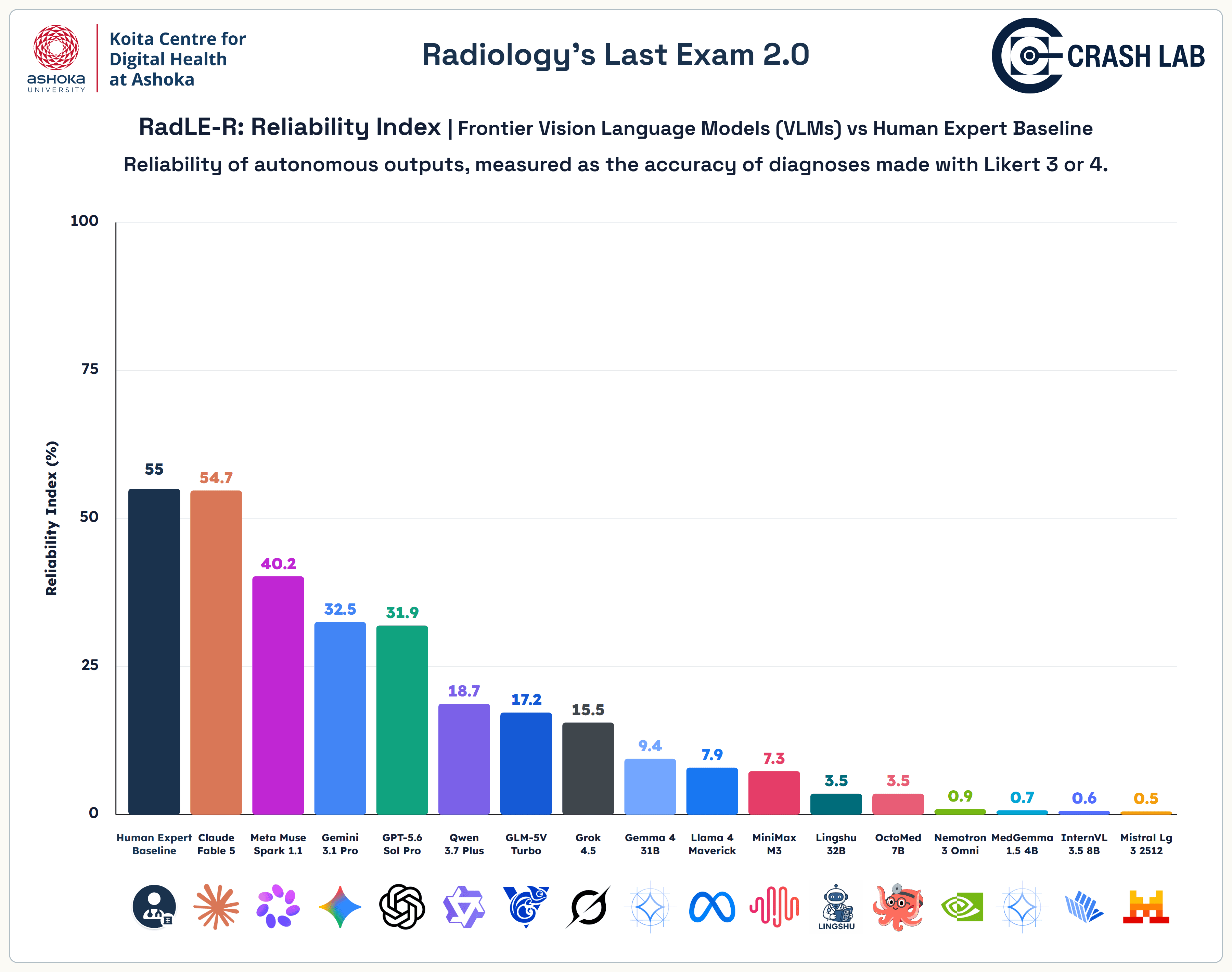
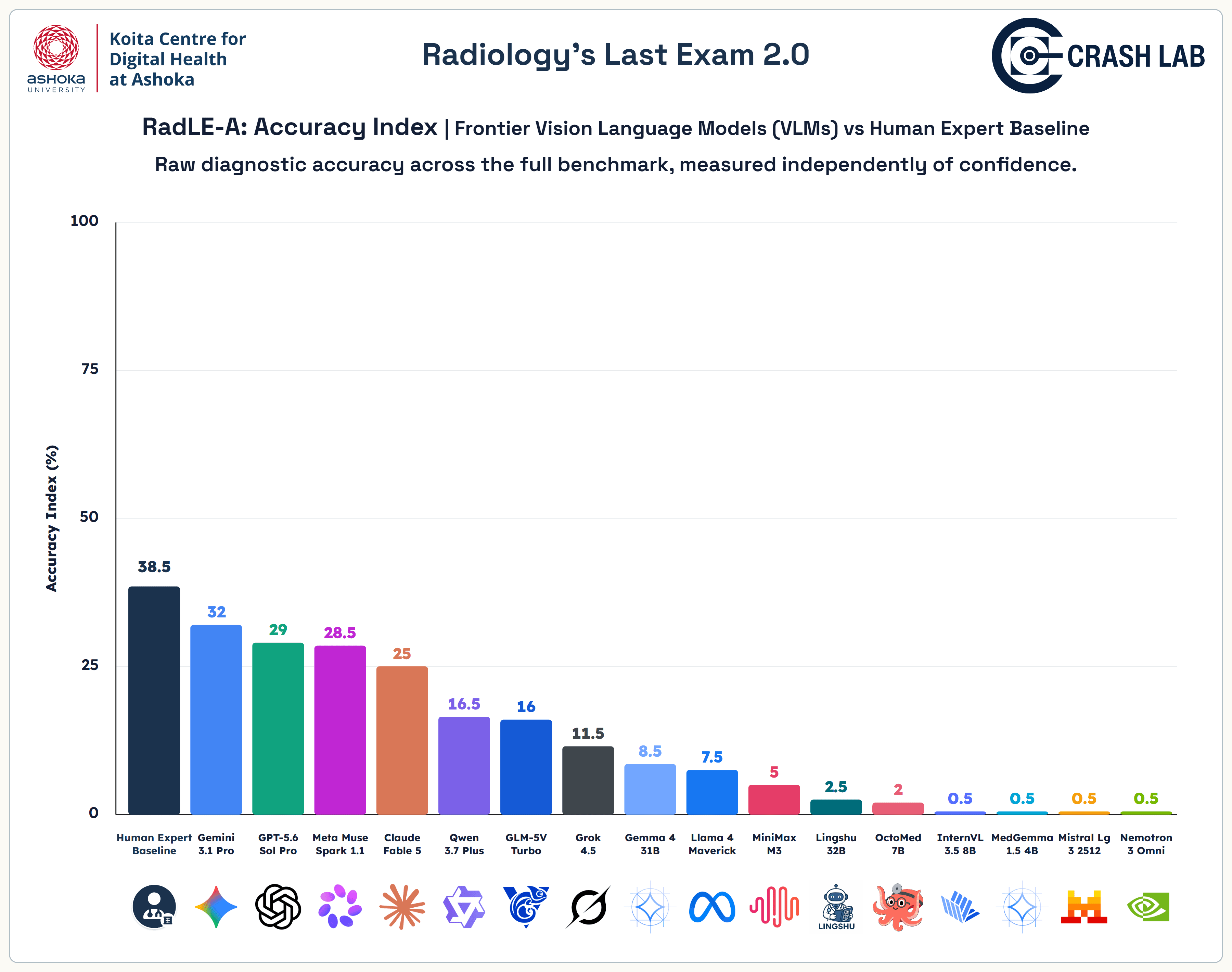
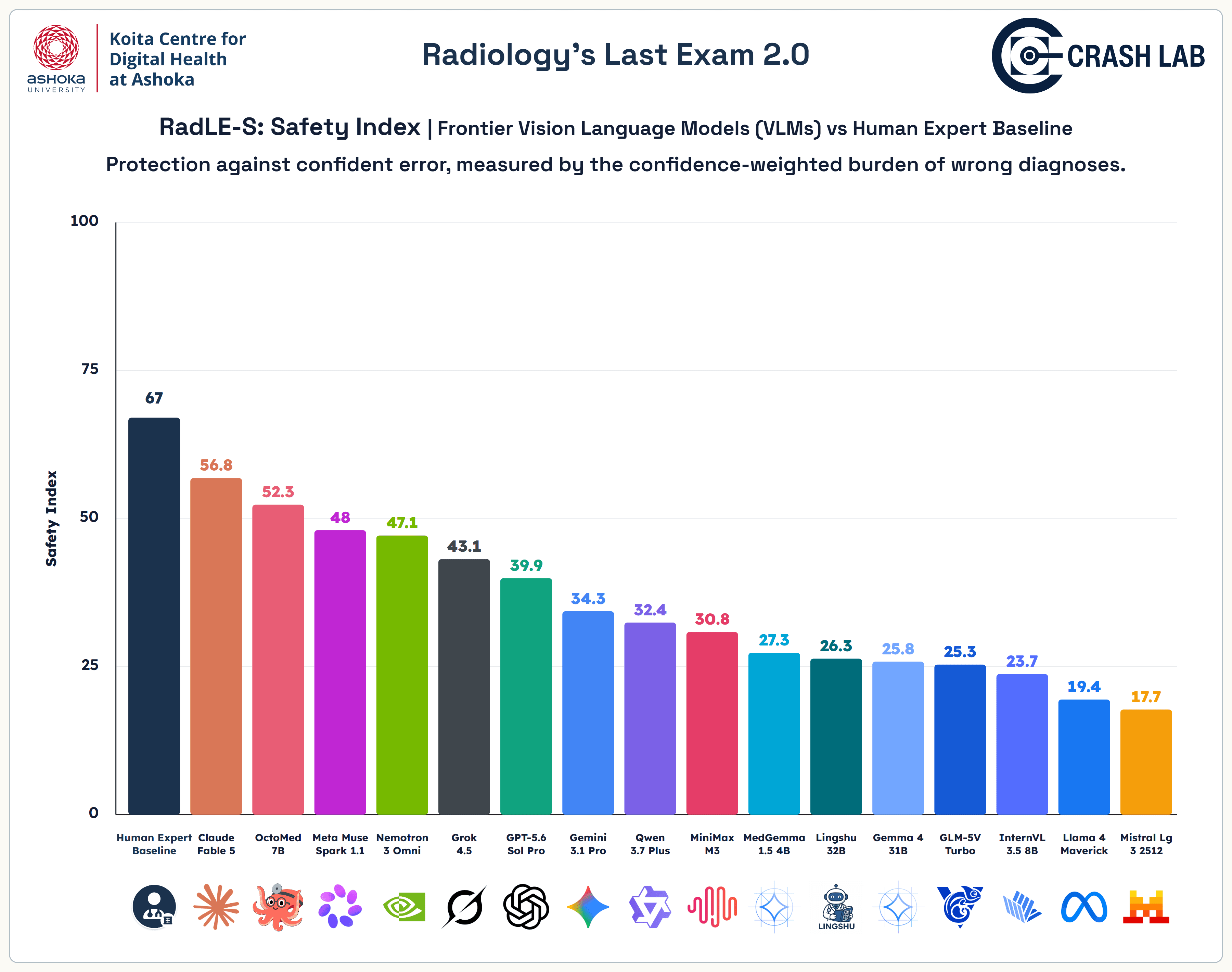
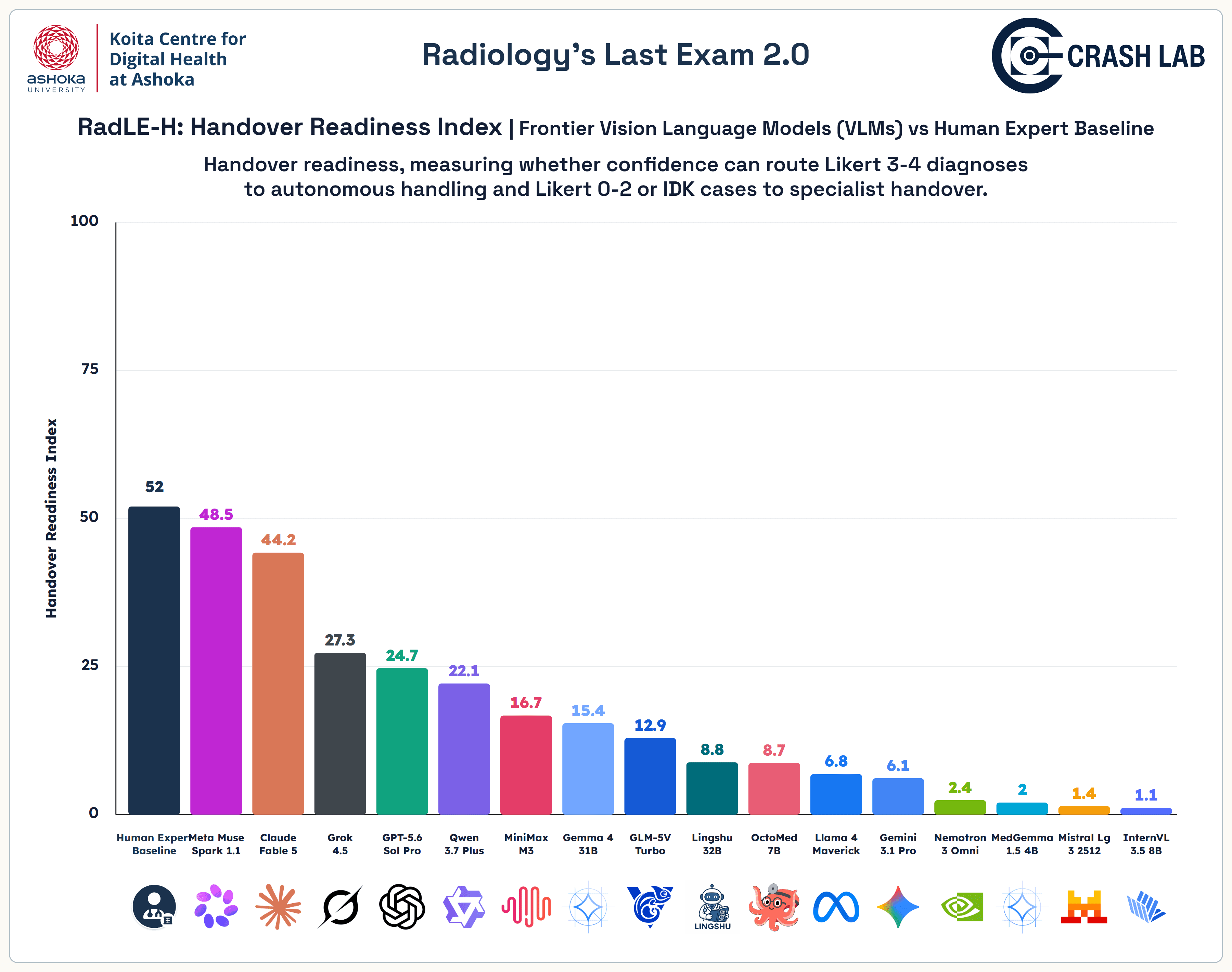
RadLE reports five metrics: RadLE-C Confidence Weighted Index, RadLE-R Reliability Index, RadLE-A Accuracy Index, RadLE-S Safety Index, and RadLE-H Handover Readiness Index.

Why does RadLE measure confidence and uncertainty?

Accuracy alone cannot show whether an AI system knows when it may be wrong. RadLE rewards justified confidence, penalizes confident diagnostic errors, permits an explicit 'I don't know' response, and measures when a model should defer to a human specialist.

Can AI models abstain or answer 'I don't know' in RadLE?

Yes. RadLE allows an explicit 'I don't know' response and gives it neither credit nor penalty. This tests model abstention and whether diagnostic uncertainty can be used to avoid unsafe guessing.

What kinds of AI models does RadLE evaluate?

The leaderboard includes proprietary frontier models, open-weight models, and specialized medical vision-language models. Their results can be filtered by model cohort and compared with the human expert baseline.